

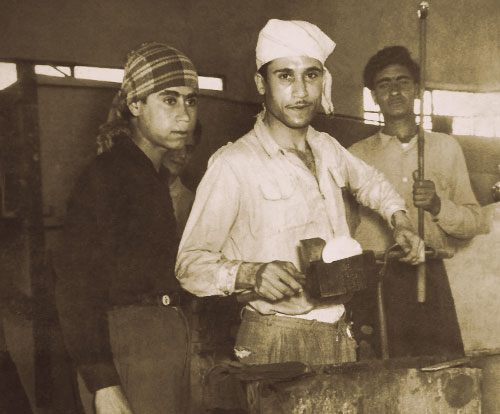
I come from a lineage that has spoken the language of glass for generations. Raised on stories of furnaces and forms, I learned early that glass is more than a material: it is continuity, responsibility, and craft. In 2021, I founded Koubaytari Glass UK Limited, a company devoted to a single, practical conviction—glass must circulate, not accumulate. We therefore specialise in empty container glass made entirely from recycled cullet, turning yesterday’s jars and bottles into tomorrow’s vessels with no compromise on clarity, form, or function.
Our purpose is deliberately twofold. Yes, we trade: bottles, jars, and gallons in a spectrum of capacities and finishes, along with closures and accessories to suit food, beverage, juice, and spirits producers, as well as distributors and brand owners. But our deeper aim is cultural: to make glass recycling habitual in the UK—to turn it from a worthy intention into a market ritual. We treat circularity not as a slogan but as an operating system.
To that end, Koubaytari Glass UK Limited developed a take-back and exchange covenant that is as simple as it is uncommon. When our clients receive defected or out-of-spec containers—whether supplied by us or by any other vendor—we collect those units, credit the account, and apply structured discounts against future and potential orders. Defects do not become waste; they become feedstock. Risk becomes resource. This policy reduces disposal costs for our partners, safeguards production schedules, and returns material to the loop where it belongs.
Upstream, we work with UK waste and resource-management companies to source post-consumer glass directly from end users. Through these partnerships, we purchase sorted glass, channel it into high-quality cullet, and contract production runs that meet modern specifications while preserving the environmental dividend that only true circularity can provide. The outcome is straightforward: containers made from 100% recycled glass, engineered for industrial performance, designed for the next cycle from the first pour.

Glass is geology made useful—sand, soda ash, limestone—melted into a vessel that can be reborn without losing its integrity. Every jar recast is a quarry left uncut; every bottle reborn is a lorry not dispatched for virgin raw materials; every cycle closed is heat and fuel the furnace does not need to spend. Circular glass shrinks the demand for extraction, lowers energy intensity in the melt, and cuts the emissions that shadow both. It reduces landfill, relieves pressure on habitats, and turns what would have been waste into the very input that sustains production. In a world negotiating climate, biodiversity, and resource security at once, circular glass is a precise, proven intervention that multiplies its benefits with each loop.
For the UK, the case is both environmental and eminently practical. This is an island economy with sophisticated manufacturing, dense logistics, and a public willing to sort at kerbside. When we capture that effort—when borough collections become reliable cullet streams; when brands, fillers, and distributors align on return and exchange; when defected containers are treated as material, not mess—we transform a municipal habit into industrial strength. Domestic cullet reduces dependency on imported virgin inputs, stabilises supply in volatile times, and shortens the miles embedded in every bottle. Cleaner melts mean cleaner air around furnaces; fewer skips headed to landfill mean cleaner ground beneath our cities. From Cornwall to the Clyde, closed-loop glass becomes an invisible public work: a quiet, continuous saving of energy, emissions, and landscape.
This is why our contracts reward returns. This is why we underwrite exchanges. This is why we purchase from waste partners and design for recyclability from the first sketch of a finish to the last turn of a cap. We want glass recycling in the UK to be more than encouraged—we want it expected. A habit, not a hashtag. A routine strong enough that sustainability stops being a special project and becomes the way business is simply done.
Our catalogue reflects this philosophy. From 30 ml miniatures to multi-litre gallons, in flint and specialty tones, with semi-finish or helix finishes and a full spectrum of closures, we assemble ranges that travel efficiently across filling lines and retail environments. For hospitality and home, we curate tableware, centrepieces, handmade items, and decorative pieces—objects that carry the tactility of craft into daily use. Every article is specified with recyclability in mind; every finish is selected to re-enter the system cleanly.
Compliance and quality are non-negotiable. We work to food-contact standards and align with international norms for safety and traceability, integrating supplier audits, lot tracking, and specification control. Commercially, we are disciplined: reliable lead times, transparent pricing, and contracts that reward consistency and responsible behaviour. Strategically, we are flexible: mixed-SKU pallets, seasonal builds, and private-label support for brands that want circularity to be visible in their packaging and their story.
I built Koubaytari Glass UK Limited to be both practical and principled. Practical, because our clients need containers that run, caps that close, and deliveries that land. Principled, because the only honest future for glass is circular. By uniting take-back protocols, recycled content, and clear commercial incentives, we help our partners turn sustainability from a cost centre into a competitive advantage.
In the end, the equation is simple: fewer holes in the ground, fewer miles on the road, fewer emissions in the air—and better bottles on the line. We trade to transform. We sell to standardise better standards. And together with our clients and waste-sector partners, Koubaytari Glass UK Limited is making the UK market a place where recycling glass is not merely possible—it is second nature.